The Evolution of Trust.
An interactive game about cooperation, incentives and repeated choices.
- Genre
- Strategy
- Before you open
- Ready to play
- Typical session
- 10 to 45 minutes
- Difficulty
- medium
- Devices
- desktop first, tablet workable
- Hosted by
- ncase.me
Quick answers about The Evolution of Trust
- Can I play The Evolution of Trust in a browser?
- Yes. The Evolution of Trust opens in a browser tab with no download and no install.
- Do I need to download anything?
- No. No installer, no plugin, no account — just ncase.me in a tab.
- Does it work on a phone?
- Yes, it plays on a phone or tablet. Rotate to landscape for anything with horizontal movement.
- How long does a session last?
- 10 to 45 minutes. Difficulty: medium.
What is The Evolution of Trust?
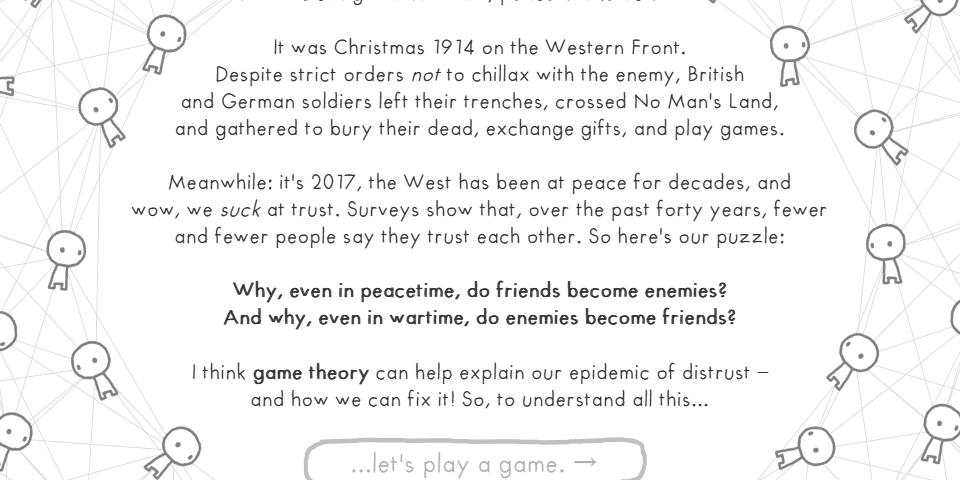
The Evolution of Trust is a strategy entry in this index, listed under strategy games and the browser pick collection. A playable argument about game theory, in about twenty minutes. It opens straight into the game with nothing to install and nothing to upload.
Hosted by ncase.me, the project's own page — their notes are more current than this listing, and nothing is mirrored here.
A playable argument about game theory that takes about twenty minutes, which is an extraordinary amount of value for twenty minutes. Every strategy you can pick — Copycat, Always Cheat, Always Cooperate, Grudger — is a different answer to the same question, and the page runs tournaments so you can watch the answers beat each other.
The lesson is not hidden. Play Copycat against Always Cheat and then play Copycat against Grudger, and the difference between those two results is the entire model: being reliably cooperative is not enough if you are unforgiving of a single mistake.
Use it as an interactive argument rather than a quiz. Run the tournaments yourself; reading about the results teaches a fraction of what seeing the graph teaches.
Strategy entries cover two very different things: turn-based economy games where a session is measured in minutes, and tower defence or merge ladders where the run lasts an hour. Closest to The Evolution of Trust by setup and browser requirements: Dinosaurs Merge Master, Takeover, DEADSHOT.io — each has its own page with the same three answers.
What do you need before playing The Evolution of Trust?
Nothing to install, nothing to upload. This one opens straight into gameplay.
How to set it up
- Open The Evolution of Trust on ncase.me in a desktop browser — or a phone, since this entry works with touch controls.
- Play — progress is normally stored in this browser only.
- Click once on the game area so it captures your keyboard and mouse — browsers do not send key events to an unfocused page.
- Play The Evolution of Trust. Progress, settings and saves are stored in this browser only, so clearing site data resets them.
How do you play The Evolution of Trust in a browser?
- Open the page and run a single tournament with Copycat on both sides.
- Then run one where you play against Always Cheat.
- Read the after-action text — that is the actual lesson.
Build economy before you build army. More strategy games ↗
What are the The Evolution of Trust controls?
| Input | Action |
|---|---|
| Left click | Choose Copycat, Always Cheat, Always Cooperate or Grudger |
| Space | Advance to the next round |
| R | Restart the tournament |
On a phone this game usually swaps these for on-screen touch controls — tap, swipe or hold. Rotate to landscape if the movement is horizontal.
How do you get better at The Evolution of Trust?
- Run the tournament with both sides set to Copycat first; it is the reference case.
- The interesting result is playing against Grudger — forgiveness is the whole model.
- The page is interactive, not a quiz; use it to test strategies rather than read about them.
Why won't The Evolution of Trust load?
| Symptom | What it means |
|---|---|
| The keyboard does nothing in The Evolution of Trust | The page has focus, not the game. Click the canvas itself once — the surrounding text, banners and scroll area do not forward key events to the game. |
| The Evolution of Trust shows a black screen after a few seconds | Usually shader compilation on the first visit of The Evolution of Trust. Give it 20 seconds; the second load is always faster than the first. |
| The Evolution of Trust runs slow and choppy | Browser games are fill-rate bound. Zoom the browser to 67–80%, close the other tabs competing for the GPU, and check chrome://gpu for hardware acceleration. |
| The Evolution of Trust still will not start | Open the link on another device or network. If it runs there, the problem is local to your browser or machine, not to the project hosting it. |
The full ordered list of fixes, including pointer lock, browser choice and site data, is in the browser game not loading guide.
Questions about The Evolution of Trust
Do I need to download anything to play The Evolution of Trust?+
No. The Evolution of Trust opens as a web page on ncase.me and asks for no installer, no plugin and no account. The only thing between you and gameplay is a browser tab.
What does The Evolution of Trust need before you open it?+
Nothing to install, nothing to upload. This one opens straight into gameplay.
Can I play The Evolution of Trust on a phone?+
Yes. The Evolution of Trust is a strategy entry, and strategy games in this index generally work on a phone or tablet. Rotate to landscape for anything with horizontal movement, and keep the tab in the foreground so the browser does not throttle it.
Is The Evolution of Trust the original game or a remake?+
A playable argument about game theory, in about twenty minutes. ncase.me hosts it, and that page is where you find out whether it is a port of, a remake of, or a completely separate browser game. Nothing is bundled or downloaded for you; you play on the host's page, and no game files pass through this site.
What is the best strategy in The Evolution of Trust?+
Copycat as a starting point, and Grudger as the interesting comparison. The game is built to show that forgiving one defection beats demanding perfect behaviour, which is easier to see than to read.